



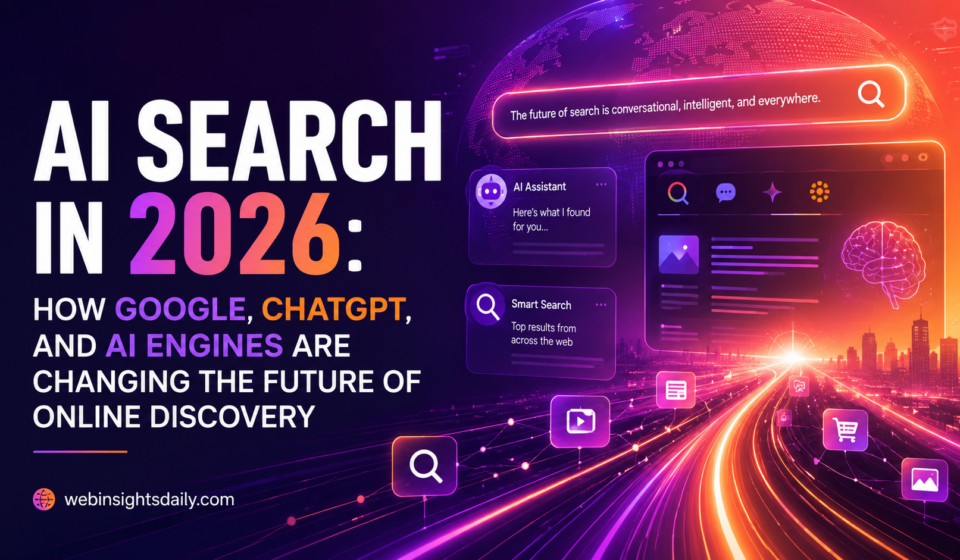
AI Search in 2026: How Google, ChatGPT, and AI Engines Are Changing the Future of Online Discovery
The way people search for information is changing faster than ever.
For more than two decades, search engines followed a simple model:
User Query → Search Results → Website Visit
Users typed keywords, clicked links, and searched through multiple pages to find answers.
Now, artificial intelligence is creating a new search experience:
User Question → AI Understanding → Direct Answer → Recommended Sources
In 2026, AI-powered search is becoming one of the biggest changes in the digital world.
Platforms such as Google AI search experiences, ChatGPT-based search systems, and other AI assistants are changing how people discover information, products, services, and businesses.
This transformation is creating a new challenge for websites:
How can businesses remain visible when users receive answers directly from AI systems?
What Is AI Search?
AI search refers to search systems that use artificial intelligence to understand user intent and provide more direct, conversational answers.
Unlike traditional search engines that mainly display links, AI search systems can:
- Understand complex questions
- Summarize information
- Compare options
- Provide recommendations
- Continue conversations
Example:
Traditional search:
“Best laptops for designers”
AI search:
“I am a graphic designer working with Adobe tools. Which laptop should I buy under $1500 and why?”
AI systems can provide a more personalized response.
How AI Search Is Different From Traditional Search
| Traditional Search | AI Search |
| Keyword matching | Intent understanding |
| List of webpages | Direct answers |
| Multiple clicks required | Conversational responses |
| Ranking-focused | Answer-focused |
| Search terms | Natural questions |
The goal of search is shifting from finding information to understanding information.
Why AI Search Is Growing in 2026
1. Users Want Faster Answers
People increasingly expect instant solutions.
Instead of browsing multiple websites, users prefer:
- Summarized information
- Clear recommendations
- Quick comparisons
AI search meets this demand by processing information faster.
2. AI Models Understand Context Better
Modern AI systems can understand:
- Previous conversations
- User preferences
- Complex questions
- Relationships between topics
This creates a more personalized search experience.
3. Businesses Need Better Digital Visibility
Traditional SEO focused heavily on ranking positions.
AI search introduces new visibility opportunities:
- Being mentioned in AI answers
- Becoming a trusted source
- Building topical authority
How AI Search Works
AI search systems combine multiple technologies:
Natural Language Processing
Helps AI understand human questions.
Machine Learning
Allows systems to improve through data patterns.
Large Language Models
Generate responses based on learned information.
Retrieval Systems
Find relevant information from available sources.
Impact of AI Search on SEO
AI search is not eliminating SEO.
It is changing SEO.
Traditional SEO focused on:
- Keywords
- Rankings
- Backlinks
Modern SEO focuses on:
- Expertise
- Authority
- Helpful content
- Entities
- User experience
The future requires combining:
SEO + GEO + Content Authority
How Websites Can Optimize for AI Search
1. Create Content That Answers Real Questions
AI systems prefer useful information.
Create content that explains:
- What
- Why
- How
- When
- Examples
2. Build Topical Authority
AI engines prefer sources that demonstrate expertise.
Businesses should create content clusters around important topics.
Example:
AI Marketing Topic Cluster:
- AI marketing tools
- AI advertising
- AI content strategy
- AI customer analytics
3. Improve E-E-A-T Signals
Strong trust signals include:
- Expert authors
- Real experience
- Original research
- Case studies
- Accurate references
4. Structure Content Clearly
AI systems understand organized information better.
Use:
- Clear headings
- Tables
- FAQs
- Definitions
- Step-by-step guides
AI Search and Businesses
AI search will impact businesses in several ways.
E-commerce
AI can recommend products based on customer needs.
Travel
AI can create personalized travel plans.
Healthcare
AI can provide health information while connecting users with trusted sources.
Finance
AI can explain financial concepts and compare options.
AI Search and Content Marketing
Content strategies must evolve.
Future content should focus on:
Original Insights
AI-generated summaries are common. Unique perspectives create value.
First-Hand Experience
Real examples and expert opinions become more important.
Comprehensive Coverage
Detailed resources are more likely to be referenced.
Challenges of AI Search
Accuracy Concerns
AI systems may sometimes provide incorrect information.
Source Visibility
Users may receive answers without visiting websites.
Changing SEO Metrics
Traffic and rankings alone may not measure visibility.
Trust Issues
AI systems need reliable sources to provide accurate answers.
The Future of AI Search
AI search will continue becoming more integrated into everyday activities.
Future developments may include:
- AI shopping assistants
- Personalized research assistants
- Voice-based search experiences
- Autonomous discovery agents
Search will move from:
“Finding information”
to:
“Helping users make decisions.”
Frequently Asked Questions
What is AI search?
AI search uses artificial intelligence to understand questions and provide direct, conversational answers.
Will AI search replace Google?
AI search will change how people use search engines, but traditional search will continue evolving.
Does SEO still matter with AI search?
Yes. SEO remains important because AI systems rely on high-quality, trustworthy information.
How can websites appear in AI search results?
Websites should create authoritative content, improve E-E-A-T, and optimize for user intent.
Conclusion
AI search represents the next major evolution of online discovery.
The future of search will not only be about ranking websites. It will be about becoming a trusted source that AI systems can understand and recommend.
Businesses that adapt by creating expert-driven, helpful, and structured content will have the strongest opportunities in the AI-powered search era.
