




AI Healthcare Revolution: How Artificial Intelligence Is Improving Patient Care
Healthcare has always relied on innovation to improve patient outcomes. From advanced medical equipment to digital health records, technology has continuously changed how doctors diagnose and treat diseases.
The latest transformation is being driven by artificial intelligence (AI).
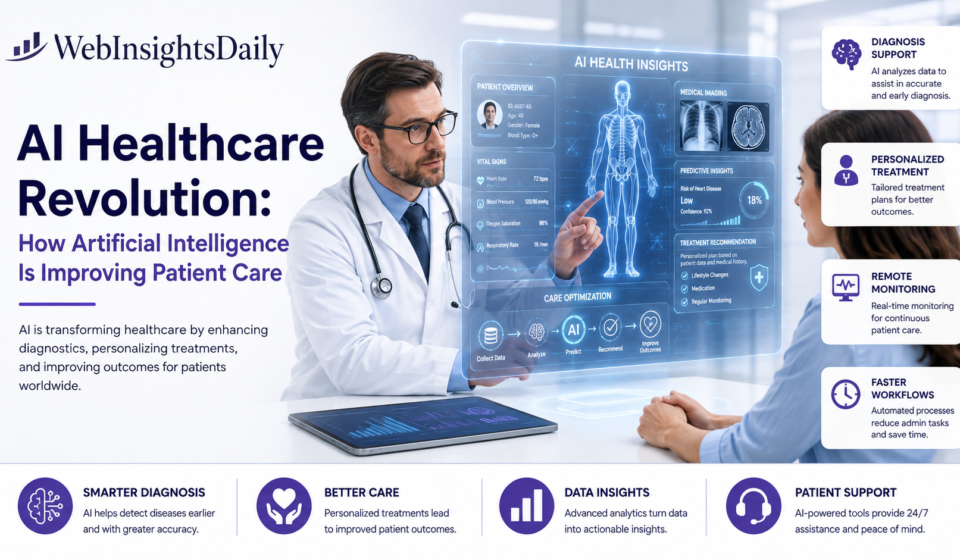
AI healthcare technology is helping doctors analyze medical information faster, identify diseases earlier, personalize treatments, and improve patient experiences.
In 2026, artificial intelligence is becoming an important support system for healthcare professionals, helping them make better decisions while allowing patients to receive more efficient and personalized care.
However, AI is not replacing doctors. Instead, it is becoming a powerful tool that supports medical expertise with advanced data analysis and automation.
What Is AI in Healthcare?
AI in healthcare refers to the use of artificial intelligence technologies to improve medical services, research, diagnosis, and patient management.
Healthcare AI systems can analyze:
- Medical images
- Patient records
- Laboratory results
- Health data from devices
- Scientific research
AI uses machine learning, natural language processing, and predictive analytics to identify patterns and provide useful insights.
Why Is AI Transforming Healthcare?
Modern healthcare produces enormous amounts of information every day.
Doctors and healthcare organizations need to analyze:
- Patient histories
- Medical scans
- Treatment outcomes
- Research studies
- Health trends
Traditional methods can be time-consuming.
AI helps healthcare professionals process information faster and identify important patterns that may support better decision-making.
Major Applications of AI in Healthcare
1. AI-Assisted Disease Diagnosis
One of the most important uses of AI is improving medical diagnosis.
AI systems can analyze medical images such as:
- X-rays
- MRI scans
- CT scans
- Ultrasound images
They can help identify patterns that may indicate health conditions.
For example, AI-powered imaging systems can assist doctors in detecting abnormalities earlier and improving diagnostic accuracy.
2. Personalized Healthcare and Treatment
Every patient is different.
AI helps healthcare providers create more personalized treatment approaches by analyzing:
- Medical history
- Genetics
- Lifestyle factors
- Previous treatments
- Patient responses
This approach helps doctors select treatments that better match individual patient needs.
3. AI in Medical Research and Drug Discovery
Developing new medicines traditionally takes years of research.
AI is helping researchers speed up the process by analyzing:
- Biological data
- Chemical compounds
- Clinical research information
AI can identify potential drug candidates faster and help researchers understand how treatments may work.
4. Virtual Health Assistants and Patient Support
AI-powered healthcare assistants are improving patient communication.
They can help with:
- Appointment scheduling
- Medication reminders
- Basic health information
- Follow-up communication
These tools improve accessibility and reduce administrative workload for healthcare teams.
5. AI in Medical Documentation
Healthcare professionals spend significant time managing paperwork.
AI tools can assist with:
- Medical notes
- Patient summaries
- Documentation management
- Administrative tasks
This allows doctors to spend more time focusing on patient care.
6. Remote Patient Monitoring
Wearable devices and connected health technologies allow continuous health tracking.
AI can analyze data from:
- Smart watches
- Fitness trackers
- Medical sensors
These systems can monitor:
- Heart rate
- Activity levels
- Sleep patterns
- Other health indicators
AI can help identify unusual patterns and support early intervention.
Benefits of AI in Healthcare
Faster Diagnosis
AI can analyze medical information quickly and support faster decision-making.
Improved Patient Experience
Digital tools make healthcare services more accessible and convenient.
Better Treatment Decisions
AI provides insights that support personalized care.
Reduced Administrative Work
Automation helps healthcare professionals save time.
Advanced Medical Research
AI accelerates discoveries in medicine and healthcare innovation.
AI Healthcare Examples
Radiology
AI systems assist doctors by analyzing medical images and identifying possible concerns.
Oncology
AI helps researchers and doctors study cancer patterns and treatment responses.
Cardiology
AI tools can analyze heart-related data and identify potential risks.
Primary Care
AI assistants help manage appointments, patient questions, and health information.
Challenges of AI in Healthcare
Patient Data Privacy
Healthcare data is highly sensitive.
Organizations must protect:
- Medical records
- Personal information
- Health data
Accuracy and Reliability
AI recommendations must be carefully reviewed by healthcare professionals.
Incorrect predictions could impact patient care.
Ethical Concerns
Healthcare organizations must address:
- Transparency
- Fairness
- Responsible AI usage
Human Oversight
AI should support medical professionals, not replace human judgment.
Doctors remain responsible for understanding patient conditions and making final decisions.
How AI Is Changing the Role of Healthcare Professionals
AI is changing healthcare jobs by reducing repetitive tasks and providing better decision-support tools.
Doctors and healthcare workers can focus more on:
- Patient communication
- Complex medical decisions
- Personalized care
- Human interaction
The future healthcare model will combine:
Medical Expertise + Artificial Intelligence = Better Patient Outcomes
Future of AI Healthcare
The future of healthcare will become increasingly connected and personalized.
AI may help create:
- More accurate early disease detection
- AI-powered medical assistants
- Faster drug development
- Personalized treatment plans
- Smarter healthcare systems
As technology improves, AI will continue supporting healthcare professionals and improving patient experiences.
Frequently Asked Questions
How is AI used in healthcare?
AI is used for diagnosis, medical research, patient monitoring, treatment support, and healthcare automation.
Can AI replace doctors?
No. AI supports doctors by providing analysis and insights, but human medical expertise remains essential.
Is AI healthcare technology safe?
AI healthcare tools require strict testing, privacy protection, and professional oversight to ensure safety.
What is the future of AI in healthcare?
AI will continue improving personalized medicine, early diagnosis, medical research, and healthcare efficiency.
Conclusion
Artificial intelligence is transforming healthcare by helping professionals make faster decisions, improve diagnosis, and provide more personalized patient care.
The future of healthcare will not be controlled by AI alone. Instead, it will be shaped by collaboration between advanced technology and human medical expertise.
AI will continue to serve as a powerful tool that helps healthcare professionals deliver better outcomes for patients around the world.