





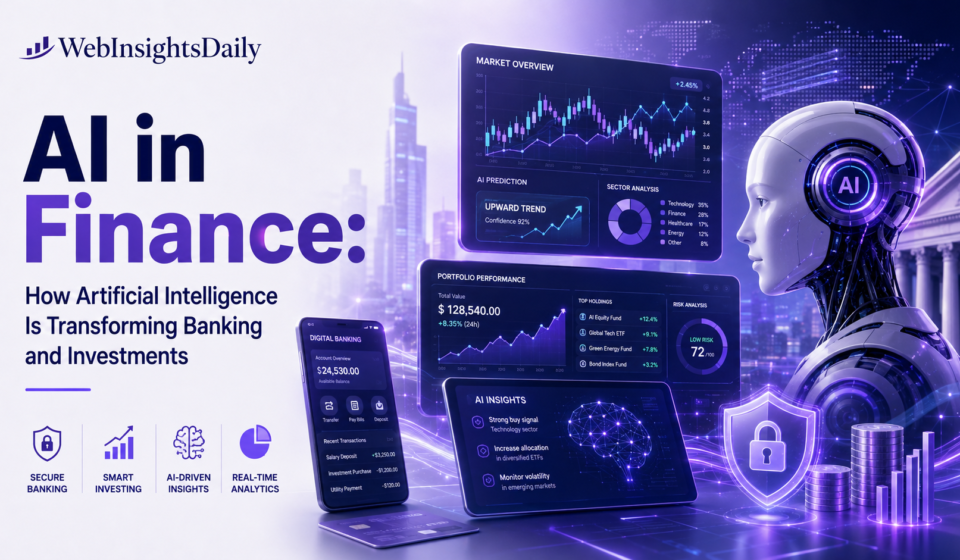
AI in Finance: How Artificial Intelligence Is Transforming Banking and Investments
The financial industry has always been driven by technology. From online banking and mobile payments to digital investments, technology has continuously changed how people manage money.
The next major transformation is being powered by artificial intelligence (AI).
AI in finance is helping banks, investment firms, and financial institutions analyze large amounts of data, automate processes, detect fraud, and deliver more personalized services.
In 2026, artificial intelligence is becoming more than an efficiency tool. It is becoming a strategic technology that helps financial organizations make faster decisions and create better customer experiences.
What Is AI in Finance?
AI in finance refers to the use of artificial intelligence technologies to improve financial services and decision-making.
Financial organizations use AI for:
- Risk analysis
- Fraud detection
- Investment management
- Customer support
- Financial forecasting
- Automated transactions
- Regulatory compliance
AI systems can process huge amounts of financial data and identify patterns that may be difficult for humans to detect manually.
Why Is AI Transforming the Finance Industry?
The financial sector generates enormous amounts of data every day.
Banks and financial institutions need to analyze:
- Customer transactions
- Market trends
- Investment behavior
- Economic indicators
- Security threats
Traditional systems often struggle with the speed and complexity of modern financial data.
AI helps organizations process information faster and make more accurate decisions.
Major Applications of AI in Finance
1. AI-Powered Fraud Detection
Fraud prevention is one of the most important uses of AI in financial services.
Traditional fraud detection systems often rely on predefined rules.
AI systems can identify unusual patterns by analyzing:
- Transaction history
- Spending behavior
- Location patterns
- Account activity
For example:
If a customer’s account suddenly shows unusual international transactions, AI can detect the abnormal behavior and trigger security checks.
2. AI in Banking Customer Service
Banks are increasingly using AI-powered assistants to improve customer support.
AI customer service systems can:
- Answer common questions
- Provide account information
- Guide customers through banking processes
- Assist with payments
- Handle service requests
This allows customers to receive faster support while human employees focus on more complex issues.
3. AI in Investment Management
AI is changing how investors analyze markets and manage portfolios.
AI investment systems can analyze:
- Market trends
- Company performance
- Economic data
- Investor behavior
Applications include:
- Portfolio optimization
- Market analysis
- Risk assessment
- Automated investment recommendations
However, investment decisions still require careful human evaluation because markets involve uncertainty.
4. AI for Risk Management
Financial institutions must evaluate risks before providing loans, investments, or services.
AI helps analyze:
- Credit history
- Financial behavior
- Market conditions
- Customer profiles
This allows banks to make more informed decisions.
5. AI-Powered Algorithmic Trading
Investment firms use AI systems to analyze market data and execute trades based on predefined strategies.
AI trading systems can process information quickly and identify opportunities.
However, financial markets remain unpredictable, and AI does not eliminate investment risks.
6. AI in Personal Finance Management
Consumers are also benefiting from AI-powered financial tools.
Personal finance AI applications can help users:
- Track spending
- Create budgets
- Identify saving opportunities
- Understand financial habits
AI-powered financial assistants can provide personalized suggestions based on individual goals.
Benefits of AI in Finance
Faster Decision Making
AI can analyze large amounts of financial data quickly.
Improved Accuracy
Machine learning models can identify patterns and reduce manual errors.
Better Customer Experience
Personalized services help customers receive more relevant financial solutions.
Reduced Operational Costs
Automation helps financial organizations reduce repetitive manual processes.
Enhanced Security
AI improves fraud detection and cybersecurity monitoring.
Challenges of AI Adoption in Finance
Data Privacy
Financial institutions handle sensitive customer information. Strong security practices are essential.
Regulatory Compliance
Banks must ensure AI systems follow financial regulations.
AI Bias
AI models can produce unfair outcomes if trained on incomplete or biased data.
Lack of Human Judgment
Complex financial decisions still require human expertise.
AI in Finance vs Traditional Financial Systems
| Traditional Finance Systems | AI-Powered Finance |
| Rule-based decisions | Data-driven predictions |
| Manual analysis | Automated insights |
| Slower processing | Real-time analysis |
| Limited personalization | Customized financial experiences |
| Reactive security | Predictive fraud detection |
How Banks Can Successfully Adopt AI
1. Build Strong Data Systems
AI requires accurate and organized financial data.
2. Focus on Security
Organizations must protect customer information and maintain transparency.
3. Train Employees
Financial professionals need AI skills to work effectively with new technology.
4. Maintain Human Oversight
AI should support financial decisions, not completely replace professional judgment.
Future of AI in Finance
The future of finance will involve deeper integration between humans and artificial intelligence.
AI will continue improving:
- Digital banking
- Investment analysis
- Fraud prevention
- Customer experiences
- Financial automation
Future financial services may become more personalized, predictive, and accessible.
Customers may receive financial guidance based on their individual goals, while institutions operate with greater efficiency.
Frequently Asked Questions
How is AI used in finance?
AI is used in finance for fraud detection, customer service, investment analysis, risk management, and financial automation.
Can AI replace financial advisors?
AI can support financial advisors by providing analysis and recommendations, but human expertise remains important for complex decisions.
Is AI safe for banking?
AI can improve banking security, but financial institutions must implement strong privacy and cybersecurity measures.
What is the future of AI in finance?
AI will continue transforming banking, investments, and financial services through automation and personalized solutions.
Conclusion
Artificial intelligence is reshaping the financial industry by making banking smarter, faster, and more secure.
From fraud detection and investment analysis to personalized financial services, AI is helping organizations improve efficiency while creating better experiences for customers.
The future of finance will not be controlled by AI alone. Instead, it will be built through collaboration between intelligent technology and human financial expertise.