



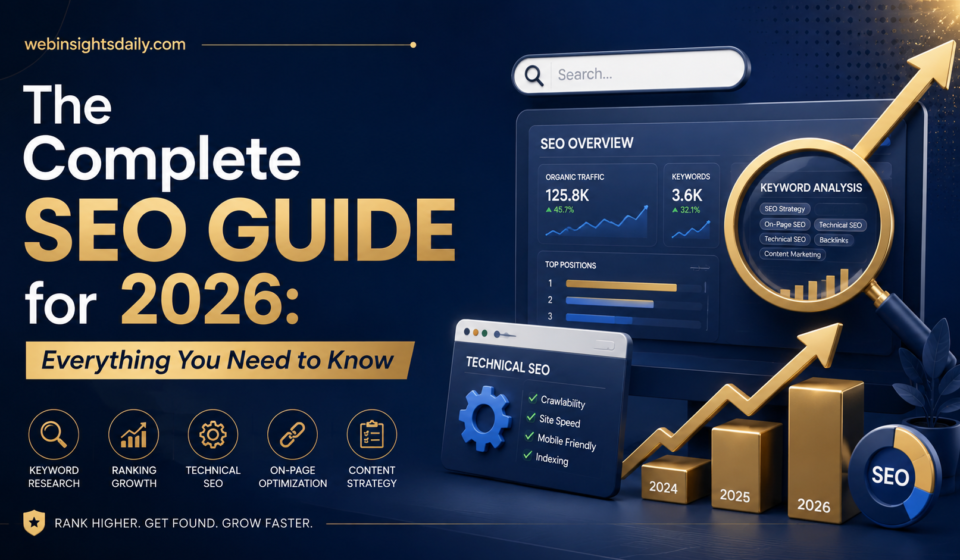
The Complete SEO Guide for 2026: Everything You Need to Know
The Complete SEO Guide for 2026: Everything You Need to Know to Rank
Search engine optimization has evolved significantly over the past few years, and 2026 brings a new era of SEO focused on user experience, content quality, and technical excellence. While the fundamentals remain unchanged, the execution and priorities have shifted. This comprehensive guide covers everything you need to know to rank competitively in 2026’s search landscape.
Understanding SEO in 2026
SEO today is about three pillar areas:
Technical SEO: Ensuring search engines can crawl, understand, and index your site On-Page SEO: Optimizing content and structure for both users and search engines Off-Page SEO: Building authority through links and brand mentions
Core Web Vitals & Page Experience
Google explicitly states page experience is a ranking factor. This means the technical performance of your site directly impacts rankings.
The Three Core Web Vitals
1. Largest Contentful Paint (LCP) – Loading Performance
- Measures how long until main content loads
- Target: Under 2.5 seconds
- Affects: Page speed ranking factor
How to Improve:
- Optimize images (use WebP, compress)
- Minimize JavaScript (reduce file sizes)
- Use Content Delivery Network (CDN)
- Upgrade hosting to faster servers
- Remove render-blocking resources
2. Interaction to Next Paint (INP) – Responsiveness
- Measures how quickly page responds to interaction
- Target: Under 200 milliseconds
- Affects: Responsiveness to user input
How to Improve:
- Optimize JavaScript processing
- Reduce main thread work
- Break long tasks into shorter chunks
- Use web workers for heavy computation
- Lazy-load non-critical elements
3. Cumulative Layout Shift (CLS) – Visual Stability
- Measures unexpected layout shifts while loading
- Target: Under 0.1
- Affects: User experience frustration
How to Improve:
- Set explicit sizes for images and videos
- Avoid inserting content above existing content
- Prevent unexpected font changes
- Use transform animations instead of layout changes
- Reserve space for ads before loading
Mobile-First Indexing
Google indexes mobile version first, desktop second. This fundamentally changes optimization priority:
Mobile Optimization Priorities:
- Mobile design responsive and touch-friendly
- Mobile loading speed critical
- Mobile text readable without zoom
- Mobile layout not cramped
- Tap targets adequate size (48px minimum)
Testing Tools:
- Google PageSpeed Insights (pagespeed.web.dev)
- Google Mobile-Friendly Test (search.google.com/test/mobile-friendly)
- GT metrix (gtmetrix.com)
- WebPageTest (webpagetest.org)
Technical SEO Foundation
Before optimizing content, ensure technical foundation is solid.
Site Architecture & Crawlability
XML Sitemap:
- Create sitemap.xml listing all pages
- Submit to Google Search Console
- Update when adding major pages
- Include priority and update frequency
Robots.txt:
- Guides search engines what to crawl/not crawl
- Blocks non-indexable pages (admin, duplicate pages)
- Specifies sitemap location
- Simple but critical file
Canonicalization:
- Specify canonical URL if multiple versions exist
- Use canonical tag in head: <link rel=”canonical” href=”URL”>
- Consolidates SEO value of duplicate content
- Critical for e-commerce with multiple URLs to same product
Internal Linking:
- Link related pages throughout site
- Use descriptive anchor text
- Prioritize important pages with link frequency
- Create site architecture directing link flow
Technical SEO Audit Checklist
- [ ] Site loads under 3 seconds (Core Web Vitals target)
- [ ] Mobile design responsive across devices
- [ ] No 404 errors from crawling
- [ ] SSL certificate installed (HTTPS, not HTTP)
- [ ] XML sitemap created and submitted
- [ ] Robots.txt optimized
- [ ] Canonical tags implemented where needed
- [ ] Structured markup (schema) implemented
- [ ] Mobile vs. desktop content identical
- [ ] No intrusive interstitials or pop-ups on mobile
On-Page SEO Optimization
Once technical foundation is solid, optimize content for search and users.
Keyword Research Strategy
Finding the Right Keywords:
- Brainstorm seed keywords (main topics)
- Use keyword tools (SEMrush, Ahrefs, Moz, Google Keyword Planner)
- Analyze competitor keywords (what’s ranking for)
- Prioritize by search volume and difficulty
- Find long-tail variations (more specific, easier to rank)
Keyword Selection Criteria:
- Search volume: 100+ monthly searches (unless hyper-niche)
- Keyword difficulty: Avoid highest difficulty initially
- Commercial intent: Align with business goals
- User intent match: Content should match what searcher needs
- Long-tail opportunity: Easier ranking with multiple variations
Keyword Types by Intent:
- Informational: “How to [do something]” – rank here for awareness
- Commercial: “Best [product type]” – rank here for consideration
- Transactional: “[Product] buy online” – rank here for sales
- Local: “[Service] near me” – rank here for local searches
Content Optimization for Keywords
Title Tag Optimization:
- Include primary keyword in first 60 characters
- Make compelling (users click from search results)
- Unique for each page
- Include benefits when possible
- Pattern: “[Primary Keyword] – [Benefit/Differentiator]”
Example: Instead of “How to Cook Pasta” Better: “How to Cook Pasta Perfectly Every Time (Pro Tips)”
Meta Description Optimization:
- Include keyword naturally
- Keep between 155-160 characters
- Write compelling description users want to click
- Include call-to-action when relevant
- Unique for each page
Header Structure (H1, H2, H3):
- One H1 per page (main topic)
- Use H2s for major sections
- Use H3s for subsections
- Include keywords naturally in headers
- Create logical hierarchy matching content structure
Content Quality & Depth:
- Comprehensive coverage of topic
- 2,000-5,000 words for competitive topics
- Original insights beyond regurgitation
- Examples and data supporting claims
- Regular updates to older content
User Experience Signals
Google increasingly measures user behavior signals:
Click-Through Rate (CTR):
- Compelling title and meta description
- Unique angle differentiating from competitors
- Trust signals (brand, awards, years)
- Numbers and power words in titles
Time on Page:
- Content matches search intent
- Engaging writing (not dry)
- Proper formatting with white space
- Multimedia breaks up text
Bounce Rate:
- Content immediately addresses intent
- Clear navigation to related content
- Internal links to related pages
- Not deceiving users with title/content mismatch
Off-Page SEO & Link Building
High-quality links remain the strongest ranking factor.
Link Building Strategies
Creating Linkable Content:
- Original research and data
- Comprehensive guides on topics
- Unique tools and calculators
- Infographics presenting data visually
- Case studies with measurable results
Outreach & Acquisition:
- Identify relevant websites to link to you
- Personalize outreach explaining why linking serves their audience
- Offer resource/collaboration
- Build relationships, not one-off transactions
- Follow up systematically
Competitor Link Analysis:
- Identify who links to competitors
- Reach out to same sources with better content
- Analyze competitor content getting links
- Replicate successful link acquisition approaches
Broken Link Building:
- Find broken links on authoritative sites
- Suggest relevant replacement content
- Provide value in notification
- Simple pitch for link exchange
Brand Mentions & Authority
Building Brand Authority:
- Get featured in industry publications
- Speak at conferences and webinars
- Contribute guest posts to authority sites
- Build relationships with journalists and influencers
- Create newsworthy content generating coverage
Local SEO (for local businesses):
- Optimize Google Business Profile
- Get local citations (directory listings)
- Collect local reviews
- Build links from local sites
- Optimize for local keywords
SEO Strategy Implementation
90-Day SEO Implementation Plan
Month 1: Foundation & Audit
- Week 1: Technical SEO audit (crawl site with SEMrush/Ahrefs)
- Week 2: Implement technical fixes (Core Web Vitals, mobile, crawlability)
- Week 3: Keyword research (identify target keywords)
- Week 4: Competitor analysis (what are they ranking for?)
Month 2: Content Strategy
- Week 1: Audit existing content (what’s ranking, what needs improvement)
- Week 2: Plan new content (what keywords need content)
- Week 3: Create 2-4 comprehensive content pieces
- Week 4: Optimize existing high-value pages
Month 3: Link Building & Promotion
- Week 1: Identify content with link potential
- Week 2: Create linkable asset (research, guide, tool)
- Week 3: Outreach for links (contact relevant sites)
- Week 4: Track results and plan next steps
SEO Metrics to Track
Quarterly Reporting:
- Organic search traffic growth
- Keyword rankings (track top 20 keywords)
- Click-through rate from search results
- Average search position
- Pages generating search traffic
Monthly Monitoring:
- New keywords ranking for
- Traffic by page and topic
- Core Web Vitals performance
- Search Console errors
- Ranking volatility
Tools for Tracking:
- Google Search Console (free – official data)
- Google Analytics (free – traffic source data)
- SEMrush or Ahrefs (paid – detailed analysis)
- Rank tracker (paid – keyword ranking history)
SEO Mistakes to Avoid
❌ Keyword stuffing: Overusing keywords hurts readability and rankings
✓ Keyword integration: Natural keyword use in content, titles, headers
❌ Duplicate content: Multiple versions confuse Google, dilute ranking
✓ Canonicalization: Tell Google which version is “official”
❌ Thin content: Short, shallow pages don’t rank
✓ Comprehensive guides: Detailed, authoritative content ranks better
❌ Buying links: Google penalizes unnatural link patterns
✓ Earning links: Create content worth linking to
❌ Ignoring mobile: 60%+ traffic is mobile, mobile ranking matters
✓ Mobile-first approach: Design for mobile, enhance for desktop
Conclusion: SEO in 2026 Requires Quality & Technology
Successful SEO in 2026 combines technical excellence with high-quality content and natural link acquisition. Quick-fix tactics don’t work; success comes from building comprehensive site authority over time.
Key Takeaway: 2026 SEO success requires a three-part strategy: technical foundation (Core Web Vitals, mobile optimization, crawlability), high-quality content optimized for user intent and keywords, and natural link building through creating valuable assets. Focus on user experience first—rankings follow.