

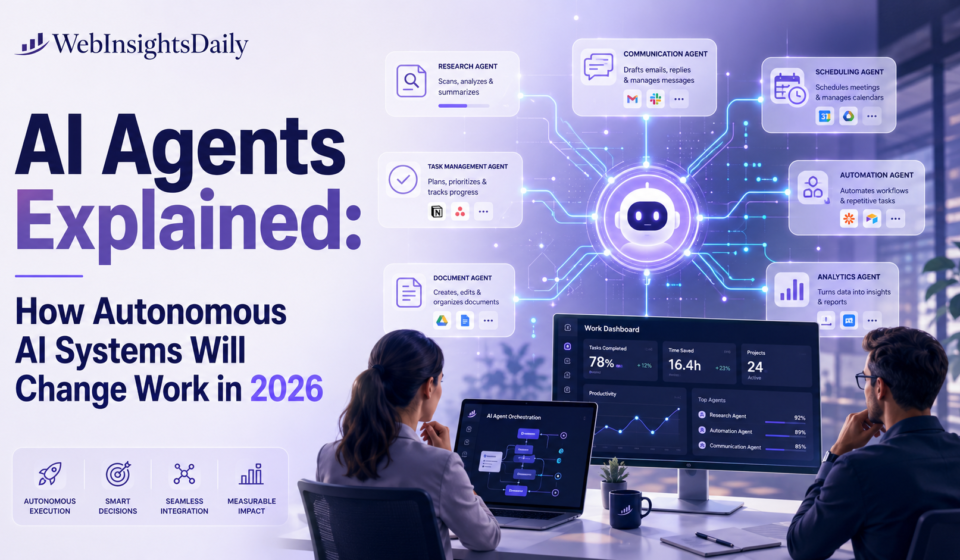
AI Agents Explained: How Autonomous AI Systems Will Change Work in 2026
Artificial intelligence has moved beyond simple chatbots and content-generation tools. The next major evolution is AI agents, systems designed to understand goals, make decisions, use tools, and complete complex tasks with limited human involvement.
Unlike traditional AI assistants that only respond to commands, AI agents can analyze situations, create action plans, execute workflows, and continuously improve their performance. Businesses are increasingly exploring agent-based AI to automate operations, improve productivity, and create smarter digital experiences.
As organizations move toward more intelligent automation, AI agents are expected to become a key part of workplace technology in 2026 and beyond.
What Are AI Agents?
AI agents are autonomous software systems that use artificial intelligence models to perform tasks, make decisions, and interact with digital environments.
A traditional AI chatbot usually works like this:
User Input → AI Response → User Action
An AI agent works differently:
Goal → Planning → Decision Making → Tool Usage → Execution → Learning
For example:
A normal AI assistant can write an email.
An AI agent can:
- Understand the purpose of the email
- Collect information from documents
- Draft the message
- Check the recipient details
- Schedule the email
- Follow up if required
This ability to complete multi-step processes makes AI agents different from traditional AI applications.
How Do AI Agents Work?
AI agents typically combine several technologies:
| Component | Purpose |
| Large Language Models (LLMs) | Understand language and reasoning |
| Memory Systems | Remember previous interactions and information |
| Planning Engine | Break complex goals into smaller tasks |
| Tool Integration | Connect with software, databases, and APIs |
| Feedback Loop | Improve decisions through results |
An AI agent does not simply predict the next sentence. It evaluates the objective, decides the required steps, and takes action.
AI Agents vs Traditional AI: Key Differences
| Traditional AI | AI Agents |
| Responds to requests | Works toward goals |
| Requires continuous instructions | Can complete multi-step tasks |
| Mostly reactive | Proactive decision-making |
| Limited context | Uses memory and external tools |
| Provides information | Performs actions |
This shift represents a move from AI as a tool to AI as a digital worker.
Why Are AI Agents Becoming Popular in 2026?
Several factors are accelerating AI agent adoption:
1. Businesses Need More Automation
Companies are looking beyond basic automation. They want systems that can manage complete workflows instead of only handling repetitive steps.
For example:
A customer support AI agent can:
- Read customer queries
- Check account information
- Suggest solutions
- Update records
- Escalate complex issues
2. AI Models Are Becoming More Capable
Modern AI systems can understand longer conversations, process multiple data sources, and interact with external applications.
This allows AI agents to handle more complicated business processes than earlier AI tools.
3. Rise of Agent-Based Business Applications
Software companies are integrating AI agents directly into business platforms for areas like:
- Customer relationship management
- Marketing automation
- Finance operations
- Human resources
- Software development
The focus is shifting from AI experiments toward measurable business outcomes.
Real-World Applications of AI Agents
1. AI Agents in Business Operations
Companies can use AI agents for:
- Data analysis
- Report generation
- Workflow management
- Customer communication
- Internal knowledge search
Example:
A sales AI agent can analyze customer behavior, identify opportunities, and recommend the next best action.
2. AI Agents in Marketing
Marketing teams can use AI agents to:
- Research competitors
- Analyze customer trends
- Generate campaign ideas
- Optimize advertisements
- Personalize customer experiences
AI agents can help marketers reduce manual research time and make faster decisions.
3. AI Agents in Software Development
Developer-focused AI agents can:
- Write code
- Identify bugs
- Create documentation
- Run tests
- Suggest improvements
Instead of replacing developers, these systems are becoming collaborative tools that improve development speed.
4. AI Agents in Healthcare
Healthcare organizations are exploring AI agents for:
- Appointment management
- Patient communication
- Medical research assistance
- Administrative automation
However, healthcare applications require strict accuracy checks and human supervision.
Benefits of AI Agents for Businesses
Increased Productivity
AI agents can handle repetitive tasks, allowing employees to focus on strategy, creativity, and decision-making.
Faster Decision Making
By analyzing large amounts of information quickly, AI agents can provide insights that support better business decisions.
Lower Operational Costs
Automation can reduce time spent on manual processes and improve efficiency.
24/7 Availability
AI agents can continuously perform tasks without traditional working-hour limitations.
Challenges and Risks of AI Agents
Despite their potential, AI agents also introduce challenges.
Data Security
AI agents often need access to company systems and sensitive information. Strong security controls are essential.
Accuracy Problems
AI agents may still make incorrect decisions if they receive incomplete or misleading information.
Human Oversight
Important decisions involving finance, healthcare, or legal matters require human review.
Trust and Governance
Organizations need clear rules about what AI agents can access and what actions they are allowed to perform. Global discussions are increasingly focusing on making AI agents more trustworthy and accountable.
Will AI Agents Replace Human Workers?
AI agents are unlikely to completely replace humans. Instead, they are expected to change how people work.
The future workplace will likely involve:
Humans + AI Agents = Higher Productivity
Humans will continue handling:
- Creativity
- Strategy
- Leadership
- Emotional intelligence
- Complex decision-making
AI agents will assist with:
- Data processing
- Automation
- Research
- Routine operations
How Businesses Can Prepare for AI Agents
Companies looking to adopt AI agents should:
1. Identify Repetitive Workflows
Start with tasks that consume significant employee time.
2. Improve Data Quality
AI systems perform better when business information is organized and accessible.
3. Establish Security Rules
Define permissions, monitoring systems, and approval processes.
4. Train Employees
Teams should understand how to collaborate effectively with AI systems.
The Future of AI Agents
The next phase of artificial intelligence will not only focus on smarter models but also on smarter actions.
AI agents are expected to become integrated into everyday business software, helping organizations automate complex workflows and improve productivity.
The future will likely not be about humans competing with AI. It will be about humans working alongside intelligent systems that extend their capabilities.
Frequently Asked Questions (FAQs)
What is an AI agent?
An AI agent is an artificial intelligence system that can understand goals, make decisions, use tools, and complete tasks with limited human input.
How are AI agents different from chatbots?
Chatbots mainly provide responses, while AI agents can plan, execute actions, and complete multi-step workflows.
Are AI agents safe to use?
AI agents can be useful, but businesses need security controls, monitoring, and human oversight to reduce risks.
Will AI agents replace jobs?
AI agents are more likely to transform jobs by automating repetitive tasks and helping employees become more productive.
Conclusion
AI agents represent the next stage of artificial intelligence. They are moving technology from simple assistance toward autonomous problem-solving and workflow execution.
For businesses, marketers, developers, and professionals, understanding AI agents today will be essential for adapting to the future of work.
The organizations that learn how to combine human expertise with AI-powered automation will have a major advantage in the coming years.