

AI Agents in Different Industries: A Deeper Look
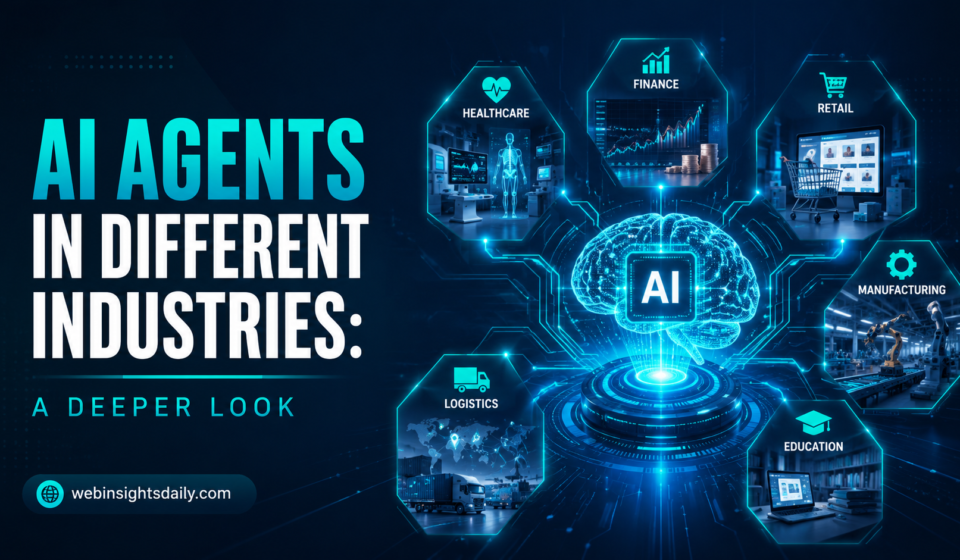
AI agents are not limited to technology companies. Their ability to understand information, make decisions, and automate workflows makes them useful across multiple industries.
AI Agents in E-commerce
Online businesses are using AI agents to improve customer experiences and increase sales.
Common applications include:
- Personalized product recommendations
- Automated customer support
- Inventory monitoring
- Price optimization
- Customer behavior analysis
For example, an AI shopping agent can understand a customer’s preferences, compare products, answer questions, and guide them toward a suitable purchase.
AI Agents in Finance and Banking
The financial sector is one of the industries expected to benefit significantly from AI agents.
Banks and financial institutions can use AI agents for:
- Fraud detection
- Customer service automation
- Financial analysis
- Risk assessment
- Document processing
A banking AI agent can analyze transaction patterns, identify unusual activity, and alert security teams faster than traditional monitoring systems.
However, financial decisions involving loans, investments, and compliance still require human supervision.
AI Agents in Human Resources
HR departments manage large amounts of employee information and repetitive administrative work.
AI agents can support HR teams by:
- Screening job applications
- Scheduling interviews
- Answering employee questions
- Managing onboarding processes
- Analyzing workforce trends
This allows HR professionals to spend more time on employee engagement and strategic planning.
AI Agents in Education
Education is another area where AI agents can create personalized learning experiences.
AI-powered learning agents can:
- Adapt lessons based on student progress
- Provide instant explanations
- Recommend learning resources
- Assist teachers with administrative tasks
Instead of offering the same learning approach to every student, AI agents can help create more personalized education systems.
Types of AI Agents
Different AI agents are designed for different levels of complexity.
Simple Reflex Agents
These agents respond to specific inputs based on predefined rules.
Example:
A chatbot answering frequently asked questions.
Goal-Based Agents
These agents work toward achieving a specific objective.
Example:
An AI assistant planning a travel itinerary based on user preferences.
Learning Agents
These systems improve their performance by analyzing previous interactions and outcomes.
Example:
A recommendation system that becomes more accurate over time.
Autonomous AI Agents
These are advanced systems capable of planning, reasoning, using tools, and completing complex tasks with minimal instructions.
AI Agent Examples You May Already Be Using
Many popular AI tools are moving toward agent-based functionality.
Examples include:
- AI coding assistants that write and test software
- Marketing automation systems that optimize campaigns
- Customer support platforms that resolve queries
- Research assistants that summarize large amounts of information
- Productivity tools that manage schedules and tasks
The transition from AI assistants to AI agents is already happening across consumer and business applications.
How AI Agents Will Impact the Workplace
The workplace of the future will likely change from task-based work to collaboration between humans and intelligent systems.
Employees may use AI agents as digital partners that help them:
- Research faster
- Analyze information
- Automate repetitive processes
- Make better decisions
- Improve creativity
For example, a marketing professional may use an AI agent to analyze customer data, suggest campaign strategies, prepare reports, and monitor results while the human focuses on brand strategy.
Skills Professionals Need in an AI Agent Era
As AI adoption increases, professionals will need new skills.
AI Literacy
Understanding how AI systems work and where they can be applied will become important across industries.
Problem-Solving Skills
Knowing what tasks to automate and how to design effective workflows will create new opportunities.
Data Understanding
AI systems depend on quality information, making data management skills increasingly valuable.
Human Skills
Creativity, communication, leadership, and critical thinking will remain important because AI cannot fully replace human judgment.
The Difference Between AI Automation and AI Agents
Although both involve automation, they work differently.
| AI Automation | AI Agents |
| Follows predefined workflows | Creates workflows based on goals |
| Requires fixed rules | Can adapt to situations |
| Handles repetitive tasks | Handles complex decision-making |
| Limited flexibility | More autonomous |
Traditional automation tells a system exactly what to do.
AI agents understand the objective and determine how to achieve it.
What Does the Future of AI Agents Look Like?
The future of AI agents will likely focus on greater reliability, better reasoning, and deeper integration with everyday software.
Future AI agents may become capable of:
- Managing complete business processes
- Working across multiple applications
- Collaborating with other AI systems
- Providing personalized digital assistance
- Supporting complex decision-making
Businesses that successfully integrate AI agents will likely gain advantages through improved efficiency and faster innovation.
Final Thoughts
AI agents represent a major shift in how people interact with technology. Instead of simply responding to commands, AI systems are becoming capable of understanding goals and taking meaningful actions.
In 2026 and beyond, AI agents will continue moving from experimental technology into practical business solutions. The companies and professionals who learn how to use these systems effectively will be better prepared for the next phase of digital transformation.
The future of work will not be about replacing human intelligence. It will be about combining human creativity with AI-powered capabilities to achieve better results.