



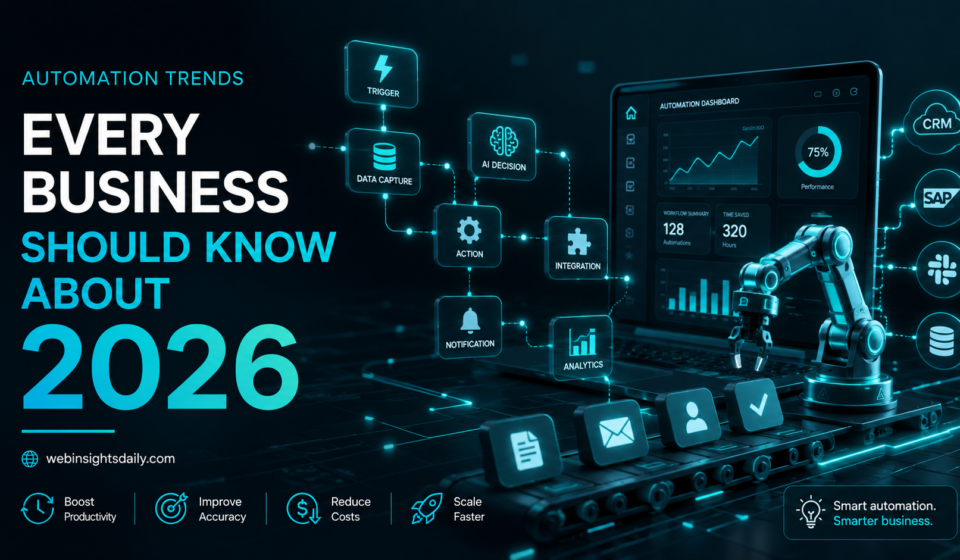
Automation Trends Every Business Should Know About 2026
Business Automation Trends Every Company Should Know About in 2026
Automation has evolved from a luxury to a necessity. Companies that automate key processes outpace competitors in efficiency, cost savings, and employee satisfaction. In 2026, automation trends are moving beyond simple rule-based processes to intelligent, AI-powered workflows that adapt and learn. This guide explores what forward-thinking companies are automating and why.
The State of Business Automation in 2026
The automation landscape has matured significantly. It’s no longer about replacing people—it’s about augmenting human capabilities. A survey of 2026’s leading companies shows:
- 78% have active automation initiatives across multiple departments
- Average ROI: 340% within first year of implementation
- Time savings: 30-50% of routine tasks eliminated
- Error reduction: 60-90% for automated processes
- Employee satisfaction: 25% higher in roles augmented by automation
Top Automation Trends in 2026
Intelligent Document Processing (IDP)
What It Is: AI-powered software that reads, understands, and extracts information from unstructured documents
What Companies Are Automating:
- Invoice processing and approval
- Contract review and analysis
- Loan applications and verification
- Insurance claims processing
- Compliance document review
Real Results:
- Processing time reduced 85%
- Error rates drop 95%
- Employees freed for strategic work
- Compliance improved through consistency
Implementation Example: A law firm automatically extracts key terms from 1,000+ contracts monthly, completing in hours what previously took weeks of paralegal time.
Workflow Automation Across Departments
What It Is: Automating multi-step business processes across teams using visual workflow tools
What Companies Are Automating:
HR Department:
- Employee onboarding workflows
- Leave request and approval
- Performance review cycles
- Expense reimbursement
- Payroll processing
Finance Department:
- Invoice-to-payment cycles
- Expense management
- Budget forecasting
- Financial reporting
- Audit trail management
Sales Department:
- Lead qualification and routing
- Proposal generation
- Contract management
- Pipeline updates
- Commission calculation
Marketing Department:
- Campaign management
- Lead nurturing workflows
- Email list management
- Social media scheduling
- Content calendar management
Real Results:
- 50% reduction in processing time
- 80% fewer manual errors
- 30% faster decision-making
- Improved employee experience
- Better compliance tracking
Robotic Process Automation (RPA)
What It Is: Software robots that mimic human actions to complete digital tasks
Current Adoption Rates:
- Large enterprises: 65% have RPA deployed
- Mid-market companies: 35% have RPA deployed
- Small businesses: 12% have RPA deployed
Common Implementations:
- Back-office reconciliation
- Data migration between systems
- Customer data updates
- Report generation and distribution
- System exception handling
ROI Impact:
- 200-300% ROI in year one
- 40-65% cost savings in automated areas
- 99%+ accuracy improvement
- 10-15x productivity increase
AI-Powered Customer Service Automation
What It Is: AI systems handling customer inquiries, complaints, and support without human involvement
Current Capabilities:
- Answer 85%+ of routine inquiries
- Resolve 60%+ of issues without escalation
- Provide 24/7 support in multiple languages
- Learn from interactions to improve
- Escalate complex issues appropriately
Business Impact:
- 40% reduction in support costs
- 50% improvement in response time
- 85%+ customer satisfaction
- Employees handle complex issues only
- Consistent quality across all interactions
Predictive Maintenance Automation
What It Is: AI systems predicting equipment failures before they happen
Manufacturing Benefits:
- 40% reduction in unplanned downtime
- 25-30% reduction in maintenance costs
- 30% longer equipment lifespan
- Optimized spare parts inventory
- Safer working environment
Implementation:
- IoT sensors monitor equipment
- AI analyzes sensor data
- System predicts failures
- Maintenance scheduled proactively
- Issues prevented before occurring
Data Pipeline Automation
What It Is: Automated movement, transformation, and analysis of data across systems
What Gets Automated:
- Data ingestion from multiple sources
- Data cleaning and standardization
- Transformation and enrichment
- Loading into data warehouse
- Report generation and distribution
Real-World Impact:
- Data available 24 hours faster
- 95% reduction in manual data work
- Real-time insights instead of delayed reports
- Improved decision-making speed
- Reduced analytical errors
Emerging Automation Technologies in 2026
Intelligent Process Automation (IPA)
What It Is: Combining RPA, AI, and machine learning for end-to-end process automation
Advantages Over Basic RPA:
- Handles unstructured data (not just structured)
- Makes decisions, not just follows rules
- Improves over time through learning
- Adapts to process changes
- Handles exceptions intelligently
Expected Impact:
- 50% more processes can be automated
- 30% higher accuracy
- Better handling of edge cases
- Less maintenance required
Hyperautomation
What It Is: Applying automation to every possible process in organization
Current Status in 2026:
- 20% of enterprises have hyperautomation strategy
- 35% consider it priority
- Expected to accelerate as benefits become clear
Benefits:
- Company-wide efficiency gains
- Coordinated automation across departments
- Cumulative ROI significantly higher
- Competitive advantage sustainable
Implementation Best Practices from Leading Companies
Successful Automation Implementation Approach
1. Process Assessment Phase (2-4 weeks)
- Identify automation candidates
- Estimate time savings and cost reduction
- Prioritize by ROI and implementation difficulty
- Get stakeholder buy-in
2. Pilot Phase (4-8 weeks)
- Automate one high-impact process
- Document actual results
- Refine workflow based on learnings
- Build internal support for expansion
3. Scaling Phase (8-16 weeks)
- Automate 3-5 additional processes
- Build internal automation expertise
- Establish governance and monitoring
- Measure and communicate ROI
4. Expansion Phase (Ongoing)
- Continuously identify new opportunities
- Invest in new automation tools
- Integrate with new systems
- Expand into new departments
Keys to Automation Success
✓ Get executive sponsorship: Leadership support is critical
✓ Engage employees: They understand processes best
✓ Start with quick wins: Build momentum with achievable targets
✓ Measure everything: Track time saved, errors eliminated, ROI
✓ Plan for change management: Employees need training and support
✓ Build internal expertise: Don’t be dependent on external consultants
✓ Document processes: Clear documentation enables better automation
✓ Regular maintenance: Automated processes need monitoring and updates
Common Automation Pitfalls to Avoid
❌ Automating bad processes: First improve, then automate
❌ Ignoring employee concerns: Involve team from beginning
❌ Setting unrealistic expectations: Benefits take time to realize
❌ Neglecting data quality: Bad data leads to bad automation
❌ Insufficient change management: Training is essential
❌ Picking wrong vendor: Platform choice matters significantly
Automation ROI Expectations
Timeline and Results:
Year 1:
- 300-400% ROI typical
- 40-50% time savings in automated areas
- First cost recovery achieved
- Momentum for expansion builds
Year 2:
- Additional 100-150% ROI from new automations
- Process improvements from Year 1 optimizations
- Expansion into new areas
- Culture shift toward automation
Year 3+:
- Sustained benefits from established automations
- Continuous process improvements
- New tools and capabilities leveraged
- Competitive advantage sustained
Conclusion: Automation Is No Longer Optional
In 2026, automation is a business necessity, not an option. Companies investing in automation gain significant competitive advantages. The good news is that tools are mature, vendors are plentiful, and ROI is proven.
The time to start automating isn’t next year—it’s now.
Key Takeaway: Business automation in 2026 has evolved beyond basic rule-based processes to intelligent, learning systems. Smart companies are automating customer service, document processing, workflows, and maintenance—seeing 300%+ ROI while freeing employees for strategic work. Start with quick-win projects and expand systematically.