

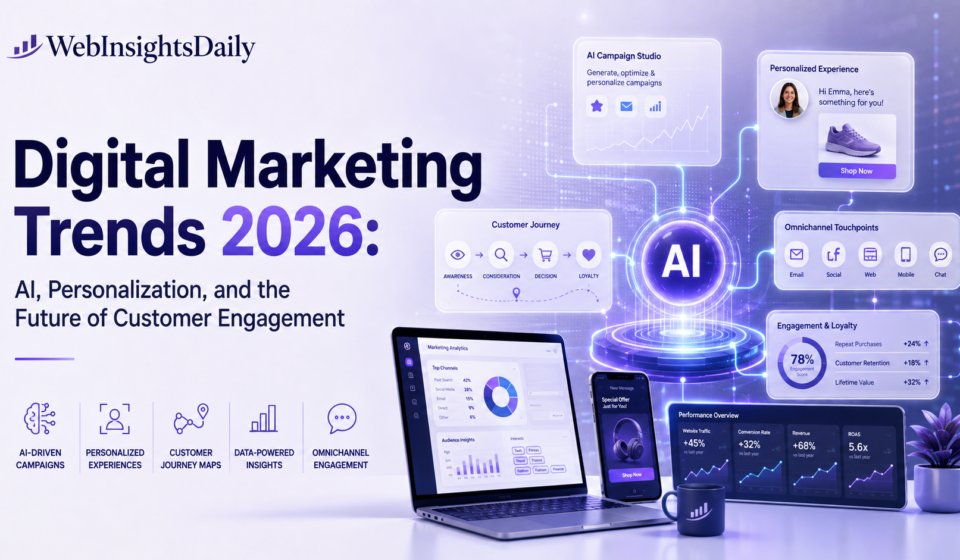
Digital Marketing Trends 2026: AI, Personalization, and the Future of Customer Engagement
Digital marketing is entering a new phase where artificial intelligence, automation, and personalized customer experiences are becoming the foundation of successful marketing strategies.
For years, businesses focused on attracting visitors through search engines, social media, and online advertising. However, changing consumer behavior and rapid AI adoption are transforming how brands connect with customers.
In 2026, successful marketers will not only focus on visibility but also on creating meaningful, personalized, and data-driven experiences.
From AI-generated campaigns to predictive analytics and conversational search, the future of digital marketing will be defined by smarter technology and deeper customer understanding.
The Evolution of Digital Marketing in 2026
Digital marketing has moved through several major stages:
| Era | Marketing Approach |
| Early Internet | Website and email marketing |
| Search Era | SEO and search advertising |
| Social Era | Community and influencer marketing |
| Mobile Era | App-based and personalized experiences |
| AI Era | Intelligent automation and predictive marketing |
The AI era focuses on helping brands understand customers better and deliver the right message at the right time.
1. Artificial Intelligence Will Transform Marketing Strategies
Artificial intelligence is becoming one of the most important technologies in digital marketing.
Businesses are using AI to improve:
- Content creation
- Customer research
- Campaign optimization
- Audience targeting
- Performance analysis
AI tools can analyze large amounts of customer data and identify patterns that humans may miss.
For example, an AI marketing system can understand customer preferences and suggest personalized campaigns based on previous interactions.
2. AI-Powered Marketing Automation
Marketing automation is moving beyond simple scheduled emails and social media posts.
Modern AI automation can:
- Create campaign ideas
- Segment audiences
- Personalize messages
- Optimize advertising budgets
- Analyze campaign performance
Instead of marketers manually managing every step, AI systems can help automate complete marketing workflows.
Example:
A brand can use AI automation to identify potential customers, send personalized communication, recommend products, and measure results.
3. Personalization Will Become the New Standard
Consumers now expect brands to understand their needs.
Generic marketing messages are becoming less effective.
In 2026, businesses will focus on hyper-personalization using:
- Customer behavior data
- AI recommendations
- Purchase history
- Location insights
- Real-time interactions
Examples of personalized experiences:
- Customized product recommendations
- Personalized emails
- Dynamic website content
- Individual customer offers
The goal is to make every customer interaction more relevant.
4. Generative AI in Content Marketing
Content marketing is being transformed by Generative AI.
AI tools are helping marketers create:
- Blog outlines
- Social media content
- Email campaigns
- Video scripts
- Marketing visuals
However, successful brands will focus on combining AI efficiency with human expertise.
The strongest content strategies will include:
- Original research
- Expert opinions
- Real experiences
- Strong brand voice
- Accurate information
AI can speed up content production, but human creativity remains essential.
5. Search Marketing Is Changing With AI Search
Search behavior is changing because users are increasingly interacting with AI-powered search experiences.
Traditional SEO focused mainly on ranking blue links.
The future of search requires businesses to optimize for:
- AI-generated answers
- Entity recognition
- Brand authority
- Helpful content
- Structured information
Marketers will need to focus on making content understandable for both search engines and AI systems.
6. Video Marketing Will Continue Growing
Video remains one of the most powerful digital marketing formats.
Brands are investing in:
- Short-form videos
- Educational content
- Product demonstrations
- Live streaming
- AI-assisted video creation
Consumers often prefer visual content because it is faster to understand and easier to engage with.
Businesses that combine storytelling with video will have stronger customer connections.
7. Voice Search and Conversational Marketing
People are increasingly using conversational interfaces to find information.
Voice and AI assistants are changing how customers interact with brands.
Businesses should focus on:
- Natural language content
- Question-based keywords
- Clear answers
- Local search optimization
Instead of targeting only short keywords, marketers should understand the questions customers ask.
8. Data Privacy Will Influence Marketing Strategies
Consumers are becoming more concerned about how companies collect and use personal information.
Future marketing strategies will require:
- Transparent data practices
- First-party data collection
- Privacy-focused personalization
- Strong security systems
Brands that build trust will have a competitive advantage.
9. Influencer Marketing Will Become More Data-Driven
Influencer marketing is becoming more strategic.
Brands are moving beyond follower counts and focusing on:
- Audience quality
- Engagement rates
- Brand alignment
- Long-term partnerships
AI tools are also helping companies identify suitable influencers and measure campaign performance.
10. Predictive Analytics Will Improve Decision Making
Predictive analytics uses AI and data to forecast future customer behavior.
Businesses can use predictive analytics to:
- Identify buying patterns
- Predict customer needs
- Improve sales strategies
- Reduce marketing waste
This allows marketers to make decisions based on data rather than assumptions.
Digital Marketing Strategies Businesses Should Adopt in 2026
Build an AI-Assisted Content Strategy
Use AI tools for research, planning, and productivity while maintaining human expertise.
Focus on Customer Experience
Marketing should not only attract customers but also create valuable experiences.
Improve First-Party Data Collection
Businesses should build direct relationships with customers through:
- Email subscribers
- Loyalty programs
- Website interactions
Optimize for AI Search
Create content that demonstrates:
- Expertise
- Authority
- Trust
- Real-world value
Challenges Marketers Need to Consider
Overdependence on AI
AI should support marketing teams, not replace creativity and strategic thinking.
Content Quality Issues
Large amounts of AI-generated content can reduce originality if not properly reviewed.
Increasing Competition
As more businesses adopt AI tools, standing out will require stronger branding and unique customer experiences.
The Future of Digital Marketing
The future of digital marketing will be built around intelligence, personalization, and automation.
Brands that understand customer needs and use technology effectively will have stronger relationships with their audiences.
The biggest shift will be moving from:
Mass Marketing → Personalized Experiences
Manual Campaigns → AI-Assisted Growth
Keyword Targeting → Customer Intent Understanding
Businesses that adapt to these changes will be better positioned for long-term digital growth.
Frequently Asked Questions
What are the biggest digital marketing trends in 2026?
The biggest trends include AI marketing, personalization, automation, AI search optimization, video marketing, and predictive analytics.
How is AI changing digital marketing?
AI helps marketers analyze data, automate tasks, personalize campaigns, and improve decision-making.
Will AI replace digital marketers?
AI will not replace marketers completely but will change how marketers work by improving productivity and efficiency.
What marketing strategy will be most important in 2026?
Customer-focused, AI-assisted, and data-driven marketing strategies will be among the most effective approaches.
Conclusion
Digital marketing in 2026 will be shaped by artificial intelligence, automation, and customer-focused experiences.
Businesses that combine technology with creativity will have the ability to reach customers more effectively and build stronger digital relationships.