


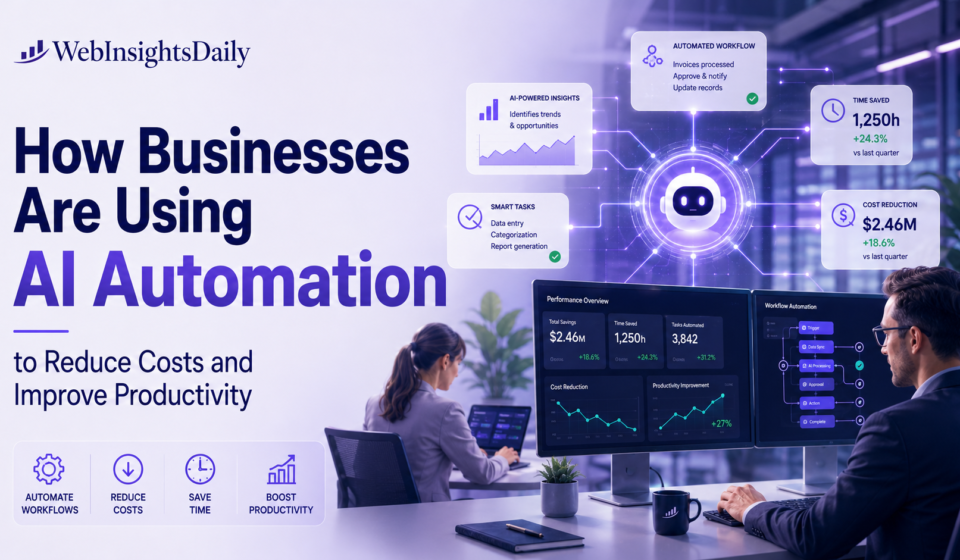
How Businesses Are Using AI Automation to Reduce Costs and Improve Productivity
Businesses across industries are rapidly adopting artificial intelligence automation to improve efficiency, reduce expenses, and create better customer experiences.
Traditional automation was mainly based on predefined rules. Companies could automate repetitive tasks, but systems had limited flexibility.
AI automation changes this approach by combining automation with machine learning, natural language processing, and intelligent decision-making.
Modern AI-powered systems can analyze information, predict outcomes, communicate with customers, and complete complex workflows with minimal human involvement.
From small businesses to global enterprises, AI automation is becoming a key strategy for improving productivity and staying competitive in 2026.
What Is AI Automation?
AI automation refers to the use of artificial intelligence technologies to automate business processes that previously required human effort.
Unlike traditional automation, AI automation can understand information, learn from patterns, and make decisions.
Examples of AI automation include:
- AI customer support assistants
- Automated data analysis
- Smart email management
- AI-powered marketing campaigns
- Automated financial reporting
- Intelligent workflow management
The goal of AI automation is not only to complete tasks faster but also to improve how businesses operate.
How AI Automation Works
AI automation combines several technologies:
| Technology | Purpose |
| Machine Learning | Identifies patterns and improves decisions |
| Natural Language Processing | Understands human language |
| Generative AI | Creates text, images, and content |
| AI Agents | Performs multi-step tasks |
| Data Analytics | Provides business insights |
A typical AI automation workflow looks like:
Data Collection → AI Analysis → Decision Making → Automated Action → Continuous Improvement
Why Businesses Are Investing in AI Automation
1. Reducing Operational Costs
One of the biggest reasons companies adopt AI automation is cost reduction.
AI systems can handle repetitive tasks that normally require significant employee time.
Examples:
- Processing invoices
- Managing customer inquiries
- Organizing documents
- Generating reports
By reducing manual workload, employees can focus on higher-value activities.
2. Improving Employee Productivity
AI automation helps employees work faster by removing repetitive tasks.
For example:
A sales team can use AI tools to:
- Analyze customer data
- Identify potential leads
- Generate follow-up emails
- Track customer interactions
Instead of spending hours on administrative work, employees can focus on building relationships and closing deals.
3. Faster Decision Making
Businesses generate large amounts of data every day.
AI automation can analyze this information quickly and provide useful insights.
Companies can use AI for:
- Market analysis
- Customer behavior prediction
- Sales forecasting
- Risk assessment
Faster access to insights helps businesses make better decisions.
AI Automation Applications Across Industries
AI Automation in Marketing
Marketing teams are using AI automation to improve campaign performance.
Common applications include:
- Personalized customer experiences
- Automated email campaigns
- Content recommendations
- Advertisement optimization
- SEO analysis
Example:
An AI marketing system can analyze customer behavior and automatically suggest the right message for different audiences.
AI Automation in Customer Service
Customer expectations for instant support are increasing.
AI automation helps companies provide faster service through:
- Chatbots
- AI support agents
- Automated ticket management
- Customer sentiment analysis
AI systems can answer common questions instantly while human agents handle complex issues.
AI Automation in Finance
Financial departments use AI automation for:
- Invoice processing
- Fraud detection
- Expense management
- Financial reporting
- Forecasting
Automation reduces errors and improves financial visibility.
AI Automation in Healthcare
Healthcare organizations are exploring AI automation for:
- Appointment scheduling
- Patient communication
- Medical documentation
- Administrative tasks
By reducing paperwork, healthcare professionals can spend more time supporting patients.
AI Automation in Human Resources
HR teams can automate:
- Resume screening
- Interview scheduling
- Employee onboarding
- Policy questions
- Workforce analysis
This allows HR professionals to focus on employee experience and company culture.
Benefits of AI Automation for Businesses
Increased Efficiency
AI systems complete repetitive processes faster than manual methods.
Reduced Human Errors
Automation improves accuracy by following consistent processes.
Better Customer Experience
Businesses can provide faster and more personalized services.
Scalability
AI automation allows companies to handle increasing workloads without proportional cost increases.
Improved Employee Satisfaction
Removing repetitive tasks allows employees to focus on creative and strategic work.
Challenges of Implementing AI Automation
Although AI automation offers many advantages, businesses must consider several challenges.
Data Privacy and Security
AI systems often require access to business information. Companies must implement strong security practices.
Initial Investment
Setting up AI automation requires investment in technology, training, and infrastructure.
Employee Training
Teams need proper training to use AI tools effectively.
Integration Problems
Businesses must ensure AI systems work properly with existing software and processes.
How Small Businesses Can Start Using AI Automation
Small businesses do not need large budgets to begin.
They can start with simple applications:
Automate Customer Communication
Use AI-powered tools to answer common customer questions.
Improve Marketing Efficiency
Automate social media scheduling, email campaigns, and content planning.
Manage Business Data
Use AI analytics tools to understand customer trends.
Automate Administrative Tasks
Reduce manual work related to invoices, scheduling, and documentation.
AI Automation vs Traditional Automation
| Traditional Automation | AI Automation |
| Rule-based processes | Intelligent decision-making |
| Limited flexibility | Learns from data |
| Handles predictable tasks | Handles complex situations |
| Requires manual updates | Can improve over time |
AI automation represents a shift from simple task automation to intelligent business operations.
Future of AI Automation in Business
The future of AI automation will focus on creating more autonomous business systems.
Companies will increasingly use AI to:
- Manage workflows
- Analyze business opportunities
- Improve customer experiences
- Support employees
- Optimize operations
AI agents and automation platforms will likely become common parts of everyday business processes.
Frequently Asked Questions
What is AI automation in business?
AI automation uses artificial intelligence technologies to automate business processes, improve efficiency, and support decision-making.
How can AI automation reduce business costs?
AI automation reduces costs by minimizing repetitive manual work, improving efficiency, and reducing operational errors.
Is AI automation only useful for large companies?
No. Small businesses can also use AI automation for customer service, marketing, accounting, and daily operations.
Will AI automation replace employees?
AI automation is mainly designed to support employees by handling repetitive tasks and allowing people to focus on strategic work.
Conclusion
AI automation is transforming how businesses operate by combining intelligent technology with automated workflows.
Companies that adopt AI automation can improve productivity, reduce costs, and create better customer experiences.
In 2026 and beyond, AI automation will become less of an optional technology and more of a competitive advantage for businesses looking to grow in a digital-first economy.