






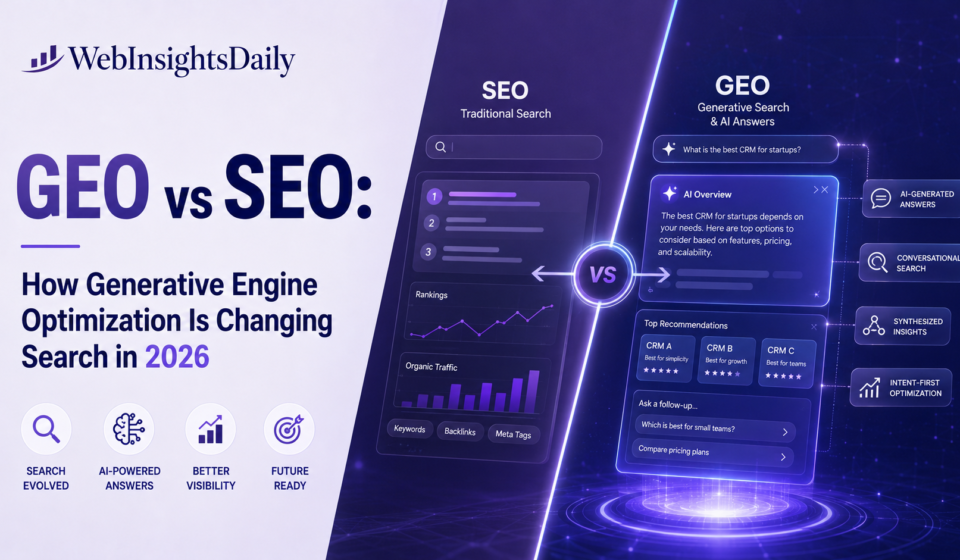
GEO vs SEO: How Generative Engine Optimization Is Changing Search in 2026
Search engines have always changed the way people discover information online.
In the early days of the internet, businesses focused on submitting websites to directories. Later, SEO became essential for ranking on Google through keywords, backlinks, and technical optimization.
Now, another major shift is happening.
The growth of AI-powered search experiences is introducing a new concept called Generative Engine Optimization (GEO).
While traditional SEO focuses on improving rankings in search engine results pages (SERPs), GEO focuses on making content understandable and useful for AI-powered search engines that generate direct answers.
As users increasingly rely on AI assistants and generative search experiences, businesses need to understand how GEO and SEO work together.
What Is SEO?
SEO (Search Engine Optimization) is the process of improving a website’s visibility in traditional search engine results.
The main goal of SEO is:
To help search engines understand content and rank pages higher for relevant searches.
SEO includes:
- Keyword optimization
- Technical SEO
- Content quality
- Internal linking
- Backlink building
- Website performance
- User experience
Example:
A travel website targeting the keyword:
“best places to visit in Japan”
would optimize its page to appear in Google’s traditional search results.
What Is GEO (Generative Engine Optimization)?
Generative Engine Optimization is the practice of optimizing content so that AI-powered search engines can understand, reference, and include it in generated answers.
Instead of only targeting a ranking position, GEO focuses on becoming a trusted information source for AI systems.
AI search platforms analyze multiple sources and create summarized responses for users.
GEO helps increase the chance that your content becomes part of those answers.
SEO vs GEO: Key Differences
| SEO | GEO |
| Optimizes for search rankings | Optimizes for AI-generated answers |
| Focuses on keywords | Focuses on meaning and context |
| Targets search engine pages | Targets AI response systems |
| Measures rankings and traffic | Measures mentions and visibility in AI answers |
| Uses backlinks and technical signals | Uses authority, clarity, and structured information |
Why Is GEO Becoming Important in 2026?
1. Search Behavior Is Changing
Users are moving from simple keyword searches toward conversational questions.
Traditional search:
“best CRM software”
AI search:
“What CRM software is best for a small business with 20 employees and why?”
AI systems provide direct answers instead of only showing website links.
2. AI Search Requires Better Context
Search engines are becoming better at understanding topics, entities, and relationships.
Content needs to clearly explain:
- Who created the information
- What topic it covers
- Why the information is trustworthy
- How it solves user problems
3. Competition for AI Visibility Is Increasing
As more businesses create online content, appearing in AI-generated answers can become a valuable source of visibility.
Companies that prepare early can build stronger digital authority.
How GEO Works
Generative AI systems evaluate content using several signals.
Content Quality
AI systems prefer:
- Accurate information
- Helpful explanations
- Original insights
- Clear structure
Authority
Trusted sources are more likely to be referenced.
Authority can be improved through:
- Expert authors
- Industry experience
- Quality backlinks
- Brand mentions
Entity Understanding
AI systems need to understand relationships between:
- People
- Companies
- Products
- Topics
- Locations
Clear entity signals improve content understanding.
How to Optimize Content for GEO
1. Create Comprehensive Content
AI systems prefer content that fully answers user questions.
Instead of writing short articles focused only on keywords, create resources that cover:
- Definitions
- Examples
- Comparisons
- Benefits
- Challenges
- FAQs
2. Answer Specific Questions
AI search often responds to detailed questions.
Create content around:
- How
- Why
- What
- When
- Which
Example:
Instead of:
“AI tools”
Create:
“How AI tools help small businesses automate marketing tasks”
3. Improve E-E-A-T Signals
Google and AI systems value experience, expertise, authority, and trust.
Improve E-E-A-T through:
- Author profiles
- Expert reviews
- Original research
- Case studies
- Real examples
4. Use Structured Content
Clear formatting helps AI understand information.
Use:
- Proper headings
- Tables
- Lists
- FAQs
- Definitions
- Comparison sections
5. Build Brand Authority
AI systems are more likely to trust recognized sources.
Businesses should focus on:
- Digital PR
- Quality mentions
- Expert contributions
- Industry publications
Does GEO Replace SEO?
No.
GEO does not replace SEO.
Instead, GEO expands SEO.
A strong digital strategy in 2026 should include:
Traditional SEO + GEO + Strong Content Authority
SEO helps websites appear in search results.
GEO helps content become part of AI-generated responses.
Both aim for the same goal:
Helping users find valuable information.
GEO Ranking Factors to Consider
While AI search algorithms continue evolving, important factors include:
Information Accuracy
AI systems need reliable information.
Content Depth
Detailed resources are more valuable than shallow content.
Brand Reputation
Trusted brands have stronger visibility.
Clear Answers
Content that directly answers questions performs better.
Fresh Information
Updated content helps maintain relevance.
Common GEO Mistakes Businesses Should Avoid
Creating AI-Generated Content Without Editing
Low-quality automated content can reduce trust.
Focusing Only on Keywords
Modern search requires understanding user intent.
Ignoring Brand Authority
Unknown websites may struggle to appear in AI answers.
Publishing Without Expertise
Content should demonstrate real knowledge and experience.
Future of Search: SEO + GEO Together
The future of search will not be only about ranking pages.
It will be about becoming a trusted source of information.
Successful websites will focus on:
- Helpful content
- Strong expertise
- Technical excellence
- Brand credibility
- AI-friendly optimization
Businesses that adapt to both SEO and GEO will have better opportunities to remain visible as search continues evolving.
Frequently Asked Questions
What is the difference between SEO and GEO?
SEO focuses on ranking websites in traditional search results, while GEO focuses on optimizing content for AI-generated search answers.
Is GEO replacing SEO?
No. GEO works alongside SEO by helping content become more visible in AI-powered search experiences.
How can businesses improve GEO?
Businesses can improve GEO by creating authoritative content, improving E-E-A-T, using structured information, and building brand authority.
Why is GEO important in 2026?
As AI search becomes more common, businesses need to optimize content for both traditional search engines and generative AI platforms.
Conclusion
The search landscape is moving from finding links to receiving intelligent answers.
SEO remains essential, but GEO represents the next stage of digital visibility.
Businesses that combine traditional optimization with AI-focused content strategies will be better prepared for the future of search.
The goal is no longer only to rank higher.
The goal is to become the trusted answer.