



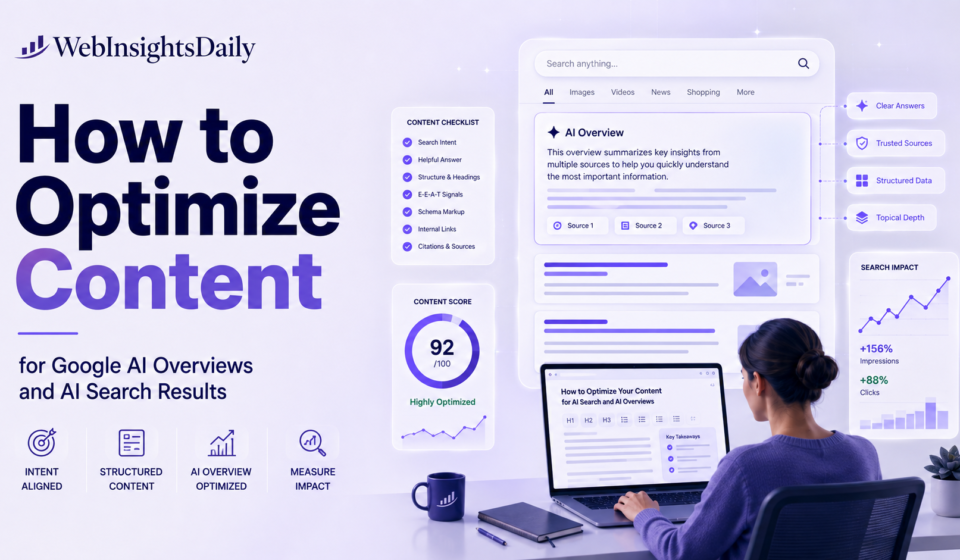
How to Optimize Content for Google AI Overviews and AI Search Results
Search is changing faster than ever.
For many years, businesses focused on ranking in traditional Google search results by optimizing keywords, backlinks, and technical SEO. However, the introduction of Google AI Overviews is changing how users discover information.
Instead of showing only a list of website links, Google can now provide AI-generated summaries that answer user questions directly.
This creates a new opportunity and challenge for website owners.
Businesses must now optimize content not only for traditional rankings but also for AI systems that select, summarize, and recommend information.
The future of SEO requires a combination of:
- Helpful content
- Strong expertise
- Technical optimization
- Clear information structure
- Brand authority
What Are Google AI Overviews?
Google AI Overviews are AI-generated summaries that appear at the top of search results for certain queries.
They provide users with quick answers by combining information from multiple sources.
For example, instead of searching:
“How does AI automation help businesses?”
A user may see an AI-generated summary explaining:
- What AI automation is
- Its benefits
- Examples
- Related considerations
The overview may also include links to sources used to generate the response.
This means websites now have another opportunity to gain visibility beyond traditional rankings.
Why Google AI Overviews Matter for SEO
1. Search Results Are Becoming More Conversational
Users are asking longer and more detailed questions.
Traditional search:
“best CRM software”
AI search:
“Which CRM software is best for a small company with a remote sales team?”
Content needs to answer real user problems instead of focusing only on keywords.
2. Visibility Is Moving Beyond Position Rankings
Previously, SEO success was measured mainly by:
- Ranking position
- Organic traffic
- Click-through rate
With AI search, brands also need to consider:
- Being referenced in AI answers
- Brand visibility
- Topical authority
- Information credibility
How Google AI Overviews Select Information
Google’s AI systems consider several factors when generating responses.
Important signals include:
Helpful and Relevant Content
Content should directly answer user questions.
Strong E-E-A-T Signals
Google values:
- Experience
- Expertise
- Authoritativeness
- Trustworthiness
Clear Content Structure
Well-organized content is easier for AI systems to understand.
Reliable Information
Accurate and updated information improves credibility.
How to Optimize Content for Google AI Overviews
1. Answer Questions Clearly and Directly
AI systems prefer content that provides clear answers.
Instead of starting with long introductions, provide useful information quickly.
Example:
Weak:
“Technology has changed significantly over many years…”
Better:
“AI automation uses artificial intelligence to complete repetitive business tasks, analyze data, and improve workflow efficiency.”
Clear answers improve understanding for both users and AI systems.
2. Create Comprehensive Topic Coverage
AI systems often combine information from multiple sources.
A complete article should cover:
- Definition
- Benefits
- Examples
- Challenges
- Comparisons
- FAQs
For example, an article about AI marketing tools should explain:
- What AI marketing tools are
- How businesses use them
- Benefits
- Limitations
- Best practices
3. Use Question-Based Headings
AI search often responds to specific questions.
Use headings such as:
- What is AI automation?
- How does AI automation work?
- What are the benefits of AI automation?
Question-based sections improve content clarity.
4. Strengthen E-E-A-T Signals
Trust is becoming increasingly important.
Improve E-E-A-T by adding:
Author Information
Include:
- Author name
- Professional background
- Expertise
Expert Contributions
Add:
- Industry opinions
- Expert reviews
- Professional insights
Original Research
Create:
- Surveys
- Data analysis
- Case studies
Real Experience
Share:
- Examples
- Lessons learned
- Practical results
5. Optimize Content Around Entities
AI systems understand the relationship between topics, people, companies, and concepts.
For example, an article about SEO should clearly mention related entities:
- Google Search
- Search Console
- Structured data
- Content quality
- User experience
Entity-focused content helps AI understand context.
6. Use Structured Content Formats
AI systems can better understand organized information.
Use:
Tables
Useful for comparisons.
Example:
| Feature | Traditional SEO | AI Search Optimization |
| Goal | Rankings | AI visibility |
| Focus | Keywords | Meaning and context |
Lists
Useful for:
- Steps
- Benefits
- Features
FAQs
Useful for answering common questions.
7. Improve Content Freshness
AI systems prefer current information.
Regularly update important pages with:
- Latest statistics
- New examples
- Updated screenshots
- Current trends
Refreshing content helps maintain relevance.
8. Improve Technical SEO Foundation
AI optimization still depends on strong technical SEO.
Important areas include:
Page Speed
Fast websites provide better user experiences.
Mobile Optimization
Most searches happen on mobile devices.
Crawlability
Search engines must access and understand content.
Structured Data
Schema markup helps search engines understand page information.
Content Types That Perform Well in AI Search
Detailed Guides
Comprehensive resources answer multiple user questions.
Comparisons
Examples:
- Product A vs Product B
- SEO vs GEO
How-To Articles
Step-by-step guides match conversational searches.
Expert Insights
Original opinions and experience improve credibility.
Research-Based Content
Unique data attracts attention and references.
Common Mistakes to Avoid
1. Writing Only for Keywords
Keyword stuffing does not help AI understanding.
2. Publishing Low-Quality AI Content
Automatically generated content without expertise may lose visibility.
3. Ignoring User Intent
Content should solve problems, not only target search terms.
4. Missing Clear Answers
Long articles without direct answers may perform poorly.
AI Overview SEO Strategy for Businesses
Businesses should focus on:
Build Topic Authority
Create multiple connected articles around important subjects.
Example:
AI Marketing Topic Cluster:
- AI marketing tools
- AI automation
- AI content creation
- AI advertising
Create Helpful Resources
Focus on answering customer questions.
Build Brand Trust
Increase visibility through:
- Industry mentions
- Expert content
- Digital PR
Future of SEO With AI Search
SEO is not disappearing.
It is evolving.
The future search ecosystem will include:
- Traditional search results
- AI-generated answers
- Voice assistants
- Conversational search
Successful websites will focus on becoming trusted information sources.
The question is changing from:
“How do I rank #1?”
to:
“How do I become the best answer?”
Frequently Asked Questions
What are Google AI Overviews?
Google AI Overviews are AI-generated summaries that provide direct answers to user queries in search results.
Does SEO still matter with AI Overviews?
Yes. Strong SEO fundamentals help search engines understand and trust website content.
How can I get my content featured in AI Overviews?
Create helpful, authoritative, well-structured content that directly answers user questions.
Does schema markup help with AI search?
Schema markup helps search engines understand content, although it is only one part of a complete optimization strategy.
Conclusion
Google AI Overviews are changing how users interact with search engines.
Businesses that want long-term visibility must optimize content for both traditional search rankings and AI-powered discovery.
The winning strategy is simple:
Create accurate, useful, expert-driven content that provides the best possible answer to users.
SEO is moving from ranking pages to earning visibility as a trusted source of information.