


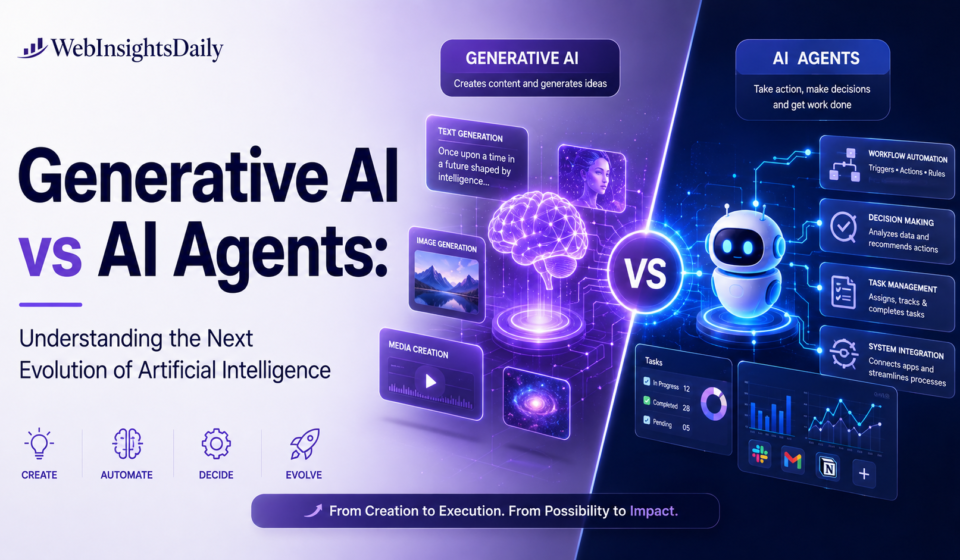
Generative AI vs AI Agents: Understanding the Next Evolution of Artificial Intelligence
Artificial intelligence has evolved rapidly over the last few years. From voice assistants and chatbots to advanced systems capable of creating content and performing complex tasks, AI is becoming a central part of modern technology.
Two terms that are gaining significant attention in 2026 are Generative AI and AI Agents.
While both technologies use artificial intelligence models, they serve different purposes.
Generative AI focuses on creating content, such as text, images, videos, code, and audio.
AI Agents go a step further by understanding goals, making decisions, using tools, and completing tasks automatically.
Understanding the difference between Generative AI and AI Agents is important for businesses, marketers, developers, and professionals who want to prepare for the next stage of AI adoption.
What Is Generative AI?
Generative AI refers to artificial intelligence systems that can create new content based on user instructions.
These systems are trained on large datasets and use machine learning models to generate responses that resemble human-created content.
Examples of Generative AI outputs include:
- Blog articles
- Marketing copy
- Images
- Videos
- Software code
- Research summaries
- Audio content
Popular Generative AI applications include AI writing assistants, image generators, coding assistants, and conversational AI platforms.
How Does Generative AI Work?
Generative AI models analyze patterns from large amounts of training data and use those patterns to create new outputs.
The process generally involves:
- User provides a prompt or instruction
- AI analyzes the request
- The model predicts and generates relevant content
- User reviews and improves the output
For example:
A user asks an AI tool:
“Write a product description for a smartwatch.”
The AI generates a product description based on learned language patterns.
However, the AI does not independently decide what action should happen next.
What Are AI Agents?
AI Agents are advanced AI systems designed to complete tasks autonomously.
Instead of only generating responses, AI agents can:
- Understand objectives
- Create action plans
- Use external tools
- Access databases
- Perform tasks
- Analyze results
- Adjust their approach
An AI agent works more like a digital employee than a content-generation tool.
For example:
A travel AI agent can:
- Understand travel preferences
- Search available flights
- Compare hotels
- Create an itinerary
- Make recommendations
- Update plans when changes occur
How Do AI Agents Work?
AI agents usually combine multiple components:
| Component | Role |
| AI Model | Understands language and reasoning |
| Memory | Stores previous information |
| Planning System | Creates task strategies |
| Tools & APIs | Performs external actions |
| Feedback System | Improves future decisions |
The main difference is that AI agents can move from thinking to doing.
Generative AI vs AI Agents: Key Differences
| Feature | Generative AI | AI Agents |
| Main Purpose | Create content | Complete tasks |
| Working Style | Reactive | Proactive |
| Human Input | Required frequently | Limited supervision |
| Decision Making | Limited | Advanced |
| Tool Usage | Usually limited | Can use multiple tools |
| Workflow | Single response | Multi-step execution |
| Example | Writing an article | Planning and publishing an article |
Real-World Examples
Example 1: Content Marketing
Generative AI:
A marketer asks:
“Write a blog introduction about AI trends.”
The AI creates the introduction.
AI Agent:
An AI agent can:
- Research trending AI topics
- Analyze competitors
- Create content outlines
- Draft articles
- Optimize SEO elements
- Schedule publishing
Example 2: Customer Support
Generative AI:
Answers customer questions through chat.
AI Agent:
Can:
- Understand customer problems
- Check account information
- Process requests
- Update systems
- Escalate issues when needed
Example 3: Software Development
Generative AI:
Creates code snippets.
AI Agent:
Can:
- Understand project requirements
- Write code
- Test applications
- Identify errors
- Suggest improvements
Why AI Agents Are Considered the Next Evolution of AI
Generative AI changed how people create information.
AI Agents are changing how people complete work.
The transition looks like this:
Traditional Software
→ Follows instructions
Generative AI
→ Creates responses
AI Agents
→ Understand goals and take actions
This shift represents a move toward more autonomous and intelligent systems.
Benefits of Generative AI
Faster Content Creation
Generative AI helps users create written, visual, and technical content quickly.
Increased Creativity
AI can provide ideas, variations, and inspiration for creative projects.
Better Productivity
Professionals can reduce time spent on repetitive content tasks.
Accessibility
AI tools allow more people to create professional-quality content without advanced technical skills.
Benefits of AI Agents
Complete Workflow Automation
AI agents can manage multiple connected tasks instead of performing only one action.
Improved Efficiency
Businesses can automate complex processes and reduce manual work.
Better Decision Support
AI agents can analyze information and recommend actions.
Continuous Operation
AI agents can perform tasks around the clock.
Limitations of Generative AI
Despite its advantages, Generative AI has limitations.
Lack of Independent Action
Most Generative AI tools wait for user instructions.
Accuracy Issues
AI-generated information may require human verification.
Limited Understanding
AI can generate responses without truly understanding real-world context.
Limitations of AI Agents
AI agents also face challenges.
Security Concerns
Giving AI systems access to business tools requires strong security controls.
Human Oversight
Important decisions still require human approval.
Reliability
Complex tasks require monitoring to ensure correct outcomes.
How Businesses Should Use Both Technologies Together
The future will not be about choosing between Generative AI and AI Agents.
Businesses can combine both.
Example:
A marketing company can use:
Generative AI for:
- Content creation
- Images
- Campaign ideas
AI Agents for:
- Research
- Workflow management
- Performance tracking
- Automation
Together, they create a more efficient AI-powered business system.
The Future of AI: From Creation to Autonomous Action
Generative AI introduced millions of people to artificial intelligence.
AI Agents represent the next step where AI systems become more capable of planning and executing tasks.
In the future, people may work with AI agents that manage daily operations, analyze information, and assist with complex decisions.
The biggest opportunity will come from combining human creativity with AI-driven automation.
Frequently Asked Questions
What is the main difference between Generative AI and AI Agents?
Generative AI creates content, while AI Agents can perform tasks, make decisions, and complete workflows.
Are AI Agents replacing Generative AI?
No. AI Agents often use Generative AI models as part of their technology stack.
Which is better for businesses: Generative AI or AI Agents?
It depends on the goal. Generative AI is useful for content creation, while AI Agents are better for automation and workflow management.
Will AI Agents become more common in the future?
Yes. Businesses are increasingly exploring AI Agents to improve productivity and automate complex processes.
Conclusion
Generative AI and AI Agents represent two important stages in artificial intelligence development.
Generative AI helps humans create faster.
AI Agents help humans work smarter by completing tasks and managing workflows.
As AI technology continues advancing, organizations that understand how to use both systems effectively will be better positioned for the future of digital transformation.